Introduction
Mixing linear lighting with decorative fixtures is no longer a stylistic curiosity — it’s a design and operational requirement for contemporary commercial interiors. Architects and hotel designers are under pressure to deliver layered lighting schemes that meet stringent aesthetic expectations while also satisfying performance, sustainability, and procurement requirements. This article offers practical, specification-focused guidance for integrating linear luminaires and decorative lighting in hotels, hospitality public areas, lobbies, corridors, restaurants, and retail spaces. We address the common B2B pain points: product quality, lead time, certification, installation complexity, and lifecycle costs — so you can turn design intent into a reliable, buildable reality.
Key Industry Insight
The interplay between continuous linear systems and decorative statement pieces creates rhythm, wayfinding, and focal points. However, achieving that balance in commercial projects requires more than design intent: it requires rigorous coordination between designers, specifiers, manufacturers, and contractors.
- Design intent vs. constructability: Designers often specify bespoke decorative fixtures alongside continuous linear runs. Without early manufacturer engagement, mismatches in mounting, power, and control can cause delays and costly rework.
- Performance expectations: High-end hospitality projects demand high CRI, consistent CCT, and controlled glare across different luminaire families. Inconsistent color or lumen output undermines the guest experience.
- Procurement constraints: Long lead times for custom decorative pieces and complex linear systems can disrupt procurement schedules. Clear priority and contingency planning are essential.
- Compliance and sustainability: Projects need luminaires with appropriate safety (UL/C-UL, CE), photometric documentation (IES/LM-79), and material certifications (RoHS, REACH). Energy efficiency ratings and end-of-life strategies are increasingly requested by clients.
Planning for Consistent Quality and Appearance
- Specify color rendering and color consistency explicitly: CRI 90+ for hospitality public spaces is often required; specify color tolerance in SDCM (≤3 SDCM recommended, ≤2 preferred for feature lighting).
- Match CCTs and fixture finishes: When using both linear and decorative fixtures, lock CCT (e.g., 2700K or 3000K) and finish codes early in documentation to prevent mismatches. Provide finish mockups where critical.
- Obtain photometric files early: Request IES or LDT files during design development to validate uniformity, illuminance levels, and contrast ratios in modeling tools (DIALux/Relux/Revit performance models).
Design & Specification Strategies
Layering lighting effectively requires intentional allocation of tasks among ambient, accent, and task layers.
- Ambient (linear systems): Use recessed or surface linear systems for general illumination and architectural definition. Continuous linear works well in corridors, underbars, and cove applications to create even ambient fields.
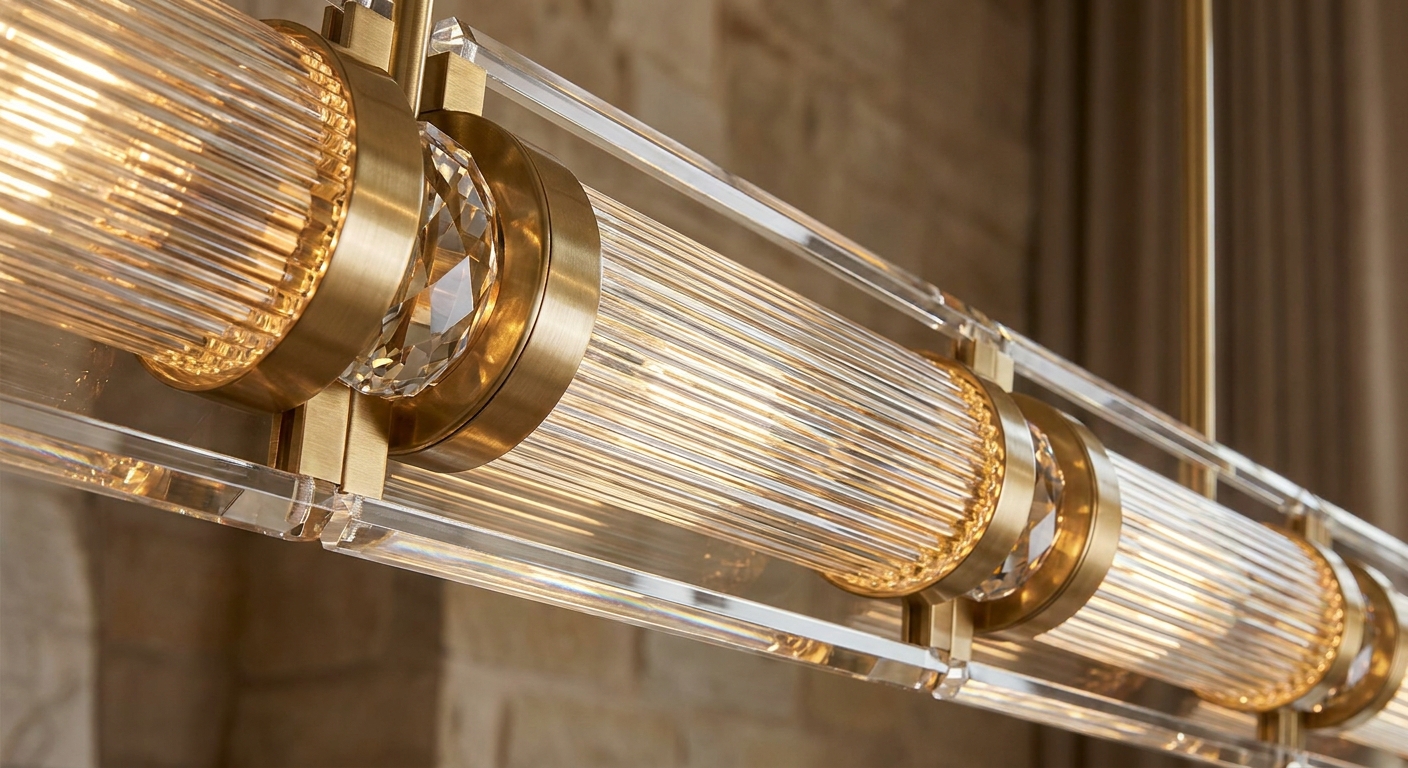
- Accent (decorative fixtures): Pendants, sculptural fixtures, and wall sconces provide focal points, human scale, and brand storytelling. Decorative fittings should integrate physically and visually with nearby linear runs.
- Task (spot and adjustable): Spot pedestals, track, or directional decorative pendants provide targeted light for seating areas or artwork.
Practical guidelines:
- Maintain visual hierarchy: Decorative fixtures should read as punctuations, not compete with continuous linear runs. Use differing intensities (decorative slightly higher or warmer) to create depth.
- Scale and spacing: For corridors, align linear runs with ceiling modules and coordinate decorative pendants with furniture plans. Typical spacing of decorative pendants in a dining setting is 24–36 inches center-to-center over tables, but adjust according to fixture scale and beam spread.
- Integration details: Where decorative pendants intersect linear channels, provide coordination drawings that show exact mounting points, canopy dimensions, and power feed locations to avoid clashes.
Technical Detail: Electrical, Controls, and Mounting
- Power distribution: Decide early whether decorative fixtures will be powered from a linear feed or separate circuits. Continuous linear runs with integrated power drops simplify supply but require careful load calculation.
- Dimming and control protocols: Confirm compatibility across fixture types. DALI-2 and DMX are common in hospitality for scene setting; 0–10V remains widely used for basic dimming. Where immersive experiences are required, specify networked control systems and ensure both linear and decorative luminaires support the same protocol.
- Addressable luminaires: For projects requiring zone or scene control, specify addressable drivers (DALI-2 DT8 for tunable white or DALI Type 8 for DT/Tunable White). Ensure manufacturer provides commissioning support or compatible gateways.
- Mounting coordination: Provide reflected ceiling plans (RCPs) with exact suspension points, slab penetrations, and structural references. For recessed linear, define plenum requirements and access panels for future maintenance.
- Thermal management: Continuous linear systems can be heat-sensitive when grouped near decorative pendants. Verify driver placement and thermal derating with the manufacturer to avoid premature failures.
Procurement, Lead Time & Manufacturing Considerations
Timely delivery often makes the difference between a successful project and one with costly delays.
- Lead times: Custom decorative fixtures often have 12–20 week lead times; engineered linear systems typically range 8–12 weeks. Specify long-lead items first and build procurement milestones aligned with construction schedules.
- Samples and mockups: Request physical samples and a mockup installation for critical areas (e.g., lobby feature, restaurant). Mockups validate finishes, scale, and light quality and are essential before bulk ordering.
- Manufacturing tolerances: For continuous linear runs, surface flatness and end-cap alignment matter. Set tolerances for run straightness and joint gaps in mm in your specification to avoid on-site surprises.
- Logistics and packaging: Ensure luminaires shipping documents include handling and orientation instructions. Project-site damage is a common cause of replacement orders that push schedules.
Certification, Testing, and Documentation
Commercial clients demand proof of performance and compliance.
- Photometric testing: Require LM-79 reports for integrated luminaires and LM-80 data for LED modules when longevity and lumen maintenance claims are made. Request TM-21 projections where warranty and life expectancy are specified.
- Safety & environmental certifications: For North America and Europe, specify UL/CSA/CE marking. For energy incentive or utility rebate programs, document DLC or ENERGY STAR listed products where applicable.
- BIM and Revit assets: Insist on BIM objects and manufacturer-validated photometric families early. Accurate BIM assets reduce clashes and provide reliable data for MEP coordination.
- Warranty & service: Define warranty duration and scope in the specification (minimum 5-year standard for commercial, extended warranties available). Clarify driver and LED module replacement procedures and lead times.
“Successful integration of linear and decorative lighting is not accidental — it’s the result of early specification, rigorous photometric validation, and manufacturer collaboration.”
Case Study Snapshot: Lobby Feature Integration (Practical Example)
- Project brief: Boutique hotel lobby with a continuous recessed linear perimeter and a cluster of bespoke decorative pendants over the reception desk.
- Challenges: Matching CCT and CRI across three fixture families, coordinating suspension points with a new truss, and meeting a tight handover schedule.
- Solutions implemented: Specified 2700K/CRI95 for all feature luminaires with ≤2 SDCM; used a single DALI-2 control backbone; ordered long-lead pendants first and prioritized linear runs for early installation; performed a full-scale mockup to confirm finish and glare control.
- Outcome: Handover on schedule, visual consistency across fixtures, simplified commissioning because of uniform control protocol and manufacturer-provided DALI addressing plan.
Conclusion
For architects and hotel designers, the successful mix of linear lighting and decorative fixtures hinges on early coordination, precise specification, and careful vendor selection. Prioritize photometric validation, consistent color metrics, unified control systems, and realistic procurement timelines to avoid common pitfalls. Artilumen partners with design teams to deliver certified, customizable linear and decorative solutions — from BIM assets and photometric data to on-site commissioning support.
Contact the Artilumen team to discuss specification templates, mockup coordination, lead-time planning, and custom finish options for your next hospitality project. Our technical team can provide IES files, LM-79/LM-80 data, BIM families, and a recommended control architecture to streamline your delivery.