
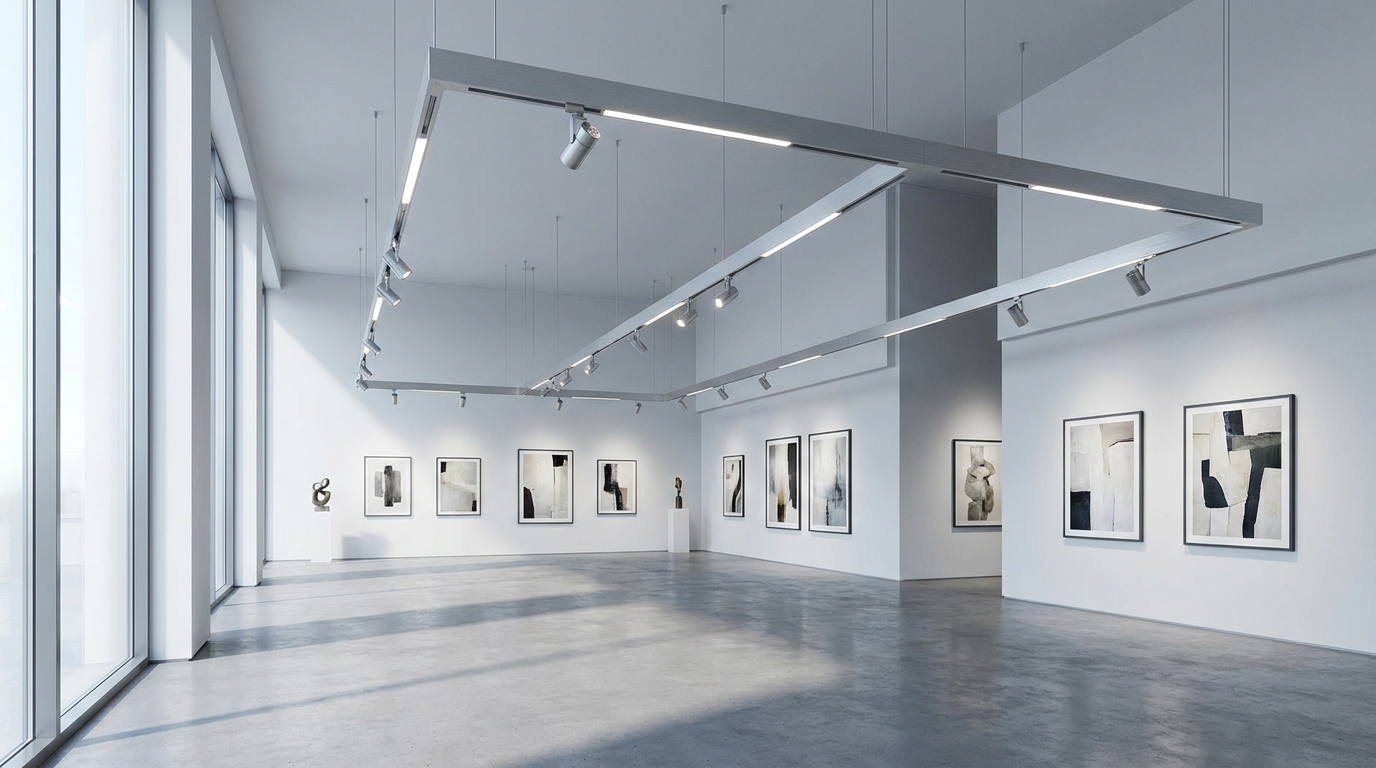
Introduction
Lighting is one of the most powerful tools an architect or hotel/curatorial designer has to shape the perception of art. In galleries, museum galleries and hotel art corridors, the choice and application of wallwashers and spotlights determine how artworks read at a distance, how details and textures resolve up close, and how collections age over time. For commercial buyers and design teams, the challenge is balancing artistic intent with conservation requirements, procurement timelines, certifications and long-term serviceability.
This article translates technical principles into design and procurement guidance for B2B stakeholders. It addresses common pain points—quality assurance, lead time management, compliance, design trends—and gives practical strategies for using wallwashers and spotlights to achieve consistent, preservative, high-impact lighting schemes.
Key Industry Insight
Successful art lighting is a systems challenge, not a product selection problem. Designers need fixtures that deliver precise photometrics, predictable color performance and long-term stability—while procurement teams demand verifiable test data, reasonable lead times and clear certification for project handover.
Key commercial considerations:
- Quality & Verification: Insist on LM79/LM80/IES files, TM-30 and spectral power distribution (SPD) data. CRI alone is not sufficient—TM-30 and spectral charts reveal color rendering nuances critical for art.
- Conservation & Standards: Coordinate with curators on maximum illuminance levels, UV/IR limits and rotation schedules. Provide specification language that aligns with accepted conservation thresholds.
- Lead Time & Modularity: Choose modular fixtures and configurable track systems to reduce long lead risks and simplify onsite changes.
- Commissioning & Controls: Lighting control protocols (DALI-2, DMX, KNX) and commissioning plans must be specified early to avoid integration delays.
Technical Detail
Fixture selection and photometric planning hinge on measurable parameters:
- Color rendering and spectrum
- Target CRI ≥ 90 for most artworks; for high-fidelity requirements consider CRI ≥ 95 and TM-30 fidelity/gamut reports.
- Provide SPD data demonstrating low emission in UV bands (<1 µW/lm, per project spec) and limited short-wave blue content where conservation demands it.
- Correlated Color Temperature (CCT)
- Typical museum ranges are 2700K–3500K. Warmer CCTs (2700–3000K) enhance warm pigments and interior warmth in hospitality corridors; cooler CCTs (3000–3500K) may be appropriate for neutral presentation of contemporary works.
- Illuminance recommendations (typical guidelines; verify with curatorial team)
- Highly light-sensitive materials (textiles, watercolors, historic photographs): often ≤ 50 lux.
- Moderately sensitive materials: 50–200 lux.
- Less sensitive media (oil paintings, sculptures): 150–300 lux depending on contrast goals.
- Uniformity and contrast
- Wallwashing should deliver consistent vertical illuminance across a plane; aim for a uniformity ratio (min/average) of 0.6 or higher for gallery walls.
- Accent spots should create a comfortable contrast between background and artwork: typical accent-to-background ratios range from 3:1 to 10:1 depending on drama and conservation constraints.
- Beam control & glare
- Use narrow and medium beam spotlights with precise shutters and field angles to control spill and minimize reflections on glazed works.
- For works behind glass, use mounting and aiming that avoids the specular reflection angle—placing fixtures outside the 45° reflection cone and preferring angled light (typically >= 30°) reduces viewing glare.
- Lumen maintenance and reliability
- Specify LM80 data and L70 lifetime ≥ 50,000 hours for LEDs. Request projected lumen maintenance curves for the chosen drive current and operating temperature.
- Dimming and flicker
- Require flicker-free performance for high-speed cameras and people-sensitive spaces. Specify testing for PstLM and SVM where needed.
- Safety and certifications
- Require local market approvals: CE/EN for Europe, UL/ETL for North America, CCC/GB for China, etc. Also include RoHS and REACH compliance where applicable.
- For public spaces, consider IP ratings and mechanical robustness (IK rating) for corridor installations.
“Art lighting succeeds when photometric precision, conservation science and buildability are treated as one integrated specification—not three separate decisions.”
Selecting the Right Fixtures: Wallwashers vs Spotlights
Wallwashers and spotlights serve complementary roles:
- Wallwashers
- Purpose: deliver even vertical illumination to reveal texture and color across the entire wall plane.
- When to use: linear galleries, long corridors, sculptural alcoves and when a uniform ambient field is required.
- Specification tips: choose asymmetric distributions, wide batwing optics or linear continuous channels depending on ceiling height and wall distance. Confirm luminaire spacing-to-mounting-height ratio from photometric data to achieve target uniformity.
- Spotlights (accent lights)
- Purpose: model and direct attention to individual works, highlight texture, reveal brushwork and create hierarchy.
- When to use: framed paintings, sculptures, display cases and focal points.
- Specification tips: specify selectable beam angles, precise tilt/rotation, and accessories (lens tubes, snoots, barn doors). For track-mounted systems, specify power rails and compatible adapters early in the design.
Practical layout rules:
- For wallwashing with linear fixtures: spacing ≈ 0.5–1.0 × mounting height from the wall for typical batwing optics (verify with vendor photometry).
- For spot lighting: choose beam angle to match artwork width at fixture distance; formula: beam angle (degrees) ≈ 2 × arctan(artwork width / (2 × throw distance)).
- Use a combination of narrow spot for modeling and wider field for overall visibility to keep visitor comfort and wayfinding consistent.
Design Trends & Hospitality Considerations
Contemporary hospitality and museum projects emphasize layered lighting, human-centric metrics and flexible exhibition spaces:
- Layered approaches: combine ambient wallwash, accent spot and case lighting to offer differentiated experiences for day/night, exhibition rotations and events.
- Tunable white and spectral tuning: select fixtures with tunable CCT where curators require adaptability for changing exhibits, but manage conservational impact when increasing brightness or blue content.
- Integrated controls and presets: implement scene-based controls and remote commissioning to support exhibit changes without invasive re-lamping.
- Aesthetic integration: low-profile recessed wallwashers and minimal track profiles preserve architectural intent in high-end hotels and galleries.
B2B Procurement & Project Delivery
Common pain points and mitigation strategies:
- Lead times: specify modular fixtures with configurable optics to reduce custom fabrication. Include milestone clauses that allow earlier delivery of core modules and later delivery of aesthetic accessories.
- Quality assurance: require sample sets and mock-ups on-site with photometric validation. Include acceptance criteria tied to lux meters and spectral measurements.
- Documentation: demand LM79/LM80, IES files, wiring diagrams, installation and service manuals as part of the RFP.
- Warranties & aftercare: negotiate multi-year warranties with defined lumen maintenance guarantees and quick-response replacement policies for mission-critical locations like museum galleries.
- Commissioning: allocate budget and schedule for light lab testing and final tuning during fit-out. Use manufacturer-trained commissioning to ensure scene accuracy.
Case Application: Hotel Art Corridor
A practical approach for a hotel corridor with rotating artworks:
- Use a continuous recessed wallwasher to provide balanced background illumination.
- Supplement with adjustable low-glare spotlights on a concealed micro-track for selective emphasis.
- Specify DALI-2 control with scene presets and a local override for maintenance staff.
- Set base wall illuminance to 75–100 lux and accent points to 225–300 lux for oil paintings, with automated reduction schedules for textile or sensitive pieces.
- Document replacement parts and ensure readily available spare modules to avoid downtime between rotations.
Conclusion
Effective museum and gallery lighting combines optical precision, conservation awareness and pragmatic procurement. For architects and hotel designers, specifying wallwashers and spotlights requires more than aesthetic choice: it requires data-driven decisions on color fidelity, spectrum, photometry, certification and lifecycle support. Early coordination with curators and procurement teams reduces risk, shortens lead times and protects the integrity of collections.
Contact the Artilumen team to discuss project-specific photometry, request LM79/LM80 data, schedule an on-site mock-up, or review specification language to ensure compliance and timely delivery. Our specialists support architects and hospitality designers with tailored fixtures, control integration and commissioning services to bring artworks to life—safely and consistently.