Introduction
Specifying lighting for architectural projects is not just about selecting fixtures that look good on a finish schedule. For architects and hotel designers, the difference between residential-grade luminaires and commercial project lighting carries consequences for safety, maintenance budgets, guest experience, regulatory compliance, and schedule risk. This buyer’s guide distills five critical criteria to help you evaluate lighting products and partners during pre-construction and renovation procurement—so you can make decisions that protect design intent, project timelines, and operating costs.
Key Industry Insight
Commercial projects—especially hospitality—demand a higher bar across performance, durability, integration, and compliance than typical residential applications. The priorities that govern product selection change: life-cycle cost and maintainability outrank upfront aesthetic price; photometric consistency and dimming fidelity are essential for guest experience; and documented testing and certification are non-negotiable for approvals and rebates.
Below are the five critical criteria with practical thresholds and specification language you can use in tender documents, schedules of work, and RFPs.
1. Performance & Light Quality
- Criterion: Color rendering, color consistency, efficacy, and lumen maintenance.
- Why it matters: In hospitality, accurate color rendering (food, finishes, skin tones) drives guest perception and brand standards.
- Practical spec:
- CRI ≥ 90 for dining, lobby, guest rooms where color fidelity is critical; CRI ≥ 80 acceptable in back-of-house.
- CCT ranges: 2700–3000K for warm hospitality ambience; 3000–3500K for public areas requiring brighter visibility.
- Binning: 3-step MacAdam ellipse or less for color consistency across hundreds of fixtures.
- Efficacy: ≥ 100 lm/W for general areas; prioritize higher where fixture counts and run-hours are large.
- Lumen maintenance: LM-80 tested LEDs with TM-21 extrapolation to L70 ≥ 50,000 hours for commercial applications.
2. Mechanical & Thermal Design (Durability)
- Criterion: Thermal management, ingress protection, mechanical robustness, and serviceability.
- Why it matters: Commercial luminaires run longer and undergo more changeovers and cleaning; poor thermal design degrades LEDs and drivers faster.
- Practical spec:
- Thermal testing results or datasheet indicating junction/ambient operating limits.
- IP ratings: IP20 for dry interiors; IP44 minimum in bathrooms; IP65 for exposed exterior fixtures.
- IK ratings where applicable (e.g., public lobbies, outdoor seating) to protect against impacts.
- Serviceability: replaceable drivers and modular optics for easier on-site maintenance and future upgrades.
3. Controls & Integration
- Criterion: Dimming performance, control protocol support, commissioning documentation.
- Why it matters: Seamless integration with BMS, DALI, KNX, or DMX is essential for scene setting, energy savings, and seamless guest experience.
- Practical spec:
- Dimming: 0.1%–100% smooth dimming where theatrical or hospitality scenes are required; verify flicker < 3% and compliance with IEEE PAR1789 guidance if flicker-sensitive applications.
- Protocols: Specify DALI-2, DALI-2 DT8 for color tuning, DMX for immersive installations, and BACnet or Modbus gateways for building-level integration.
- Provide IES/IESNA (IES LM-63) files and pixel/zone control diagrams for commissioning.
4. Certification, Testing & Documentation
- Criterion: Lab testing, safety certification, photometric files, and declared performance documents.
- Why it matters: Commercial approvals, energy code compliance, and incentive programs require documented evidence—not marketing claims.
- Practical spec:
- Photometric: Provide IES files, LM-79 reports for photometric performance, and LM-80 data for LED longevity.
- Third-party safety and energy certifications: UL/ETL (US/Canada), CE/ENEC (EU), CCC (China) as relevant to installation location.
- Quality systems: Manufacturer ISO 9001 and evidence of factory inspection processes.
- Warranty: Minimum 5-year commercial warranty with clear provisions on lumen maintenance, driver replacement, and failure thresholds.
5. Supply Chain, Lead Time & Support
- Criterion: Production lead times, customization windows, inventory strategy, and after-sales service.
- Why it matters: Long lead times pose schedule risk; inconsistent availability increases cost and delays installations and handovers.
- Practical spec:
- Lead time guidance: Off-the-shelf commercial products typically 4–6 weeks; customized fixtures or finishes 8–14 weeks—specify in procurement documents and allow contingency.
- Minimum order quantities and availability of replacement parts: Require spares kit (e.g., 3–5% of order) and documented lead time for replacements.
- Local support: On-the-ground technical reps, photometric verification, and on-site commissioning assistance.
Technical Detail
Technical documentation should be part of every proposal and submittal package. Ask for:
- LM-79 photometric reports and accompanying IES files for each proposed lumen package and optic.
- LM-80 test reports and TM-21 extrapolations showing L70 hours at stated ambient temperature.
- Driver datasheets with THD (Total Harmonic Distortion) < 20% and power factor > 0.9 for commercial-grade drivers.
- Dimming curves (analogue and digital), flicker metrics, and compatibility lists for control systems.
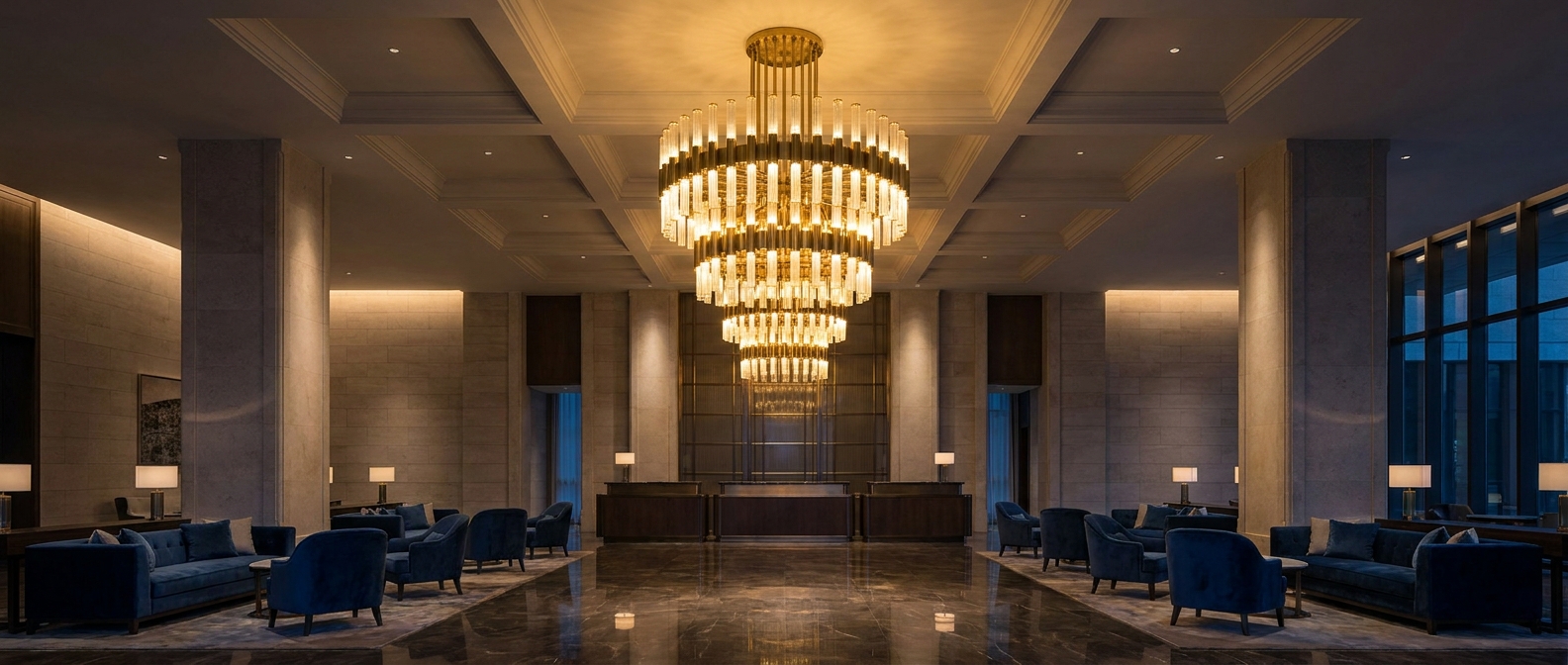
- Sample mock-ups or prototype fixtures for critical locations (e.g., lobby chandeliers, bedside reading lights) to validate color, beam, and dimming prior to production.
“For hotel projects, lighting is not décor—it’s an operational system. Specify for life-cycle performance, not just initial aesthetics.”
Application Examples & Specification Language
- Hotel Guest Room Reading Light: “LED luminaire, CRI ≥ 90, CCT 2700K ±100K, 3-step MacAdam, replaceable driver, 50,000-hour L70, bedside control interface compatible with headboard switch and DALI-2 DT8 for scene control.”
- Lobby Accent Fixtures: “Adjustable accent downlights, beam angles 15°/24°/36°, photometric IES files required, glare control lens, DALI dimmable to 0.1%, IP20, IK07.”
- Exterior Façade Wash: “Linear wall-wash LED, IP65, CRI ≥ 80, expected efficacy ≥ 110 lm/W, DMX controllable for façade events, 10-year part availability commitment.”
Common Procurement Pitfalls
- Accepting manufacturer claims without third-party test reports. Always require LM-79/LM-80 and IES files.
- Overlooking maintenance access. Fixtures that require ceiling removal for driver replacement increase operational cost.
- Ignoring control compatibility. A beautifully specified fixture that cannot integrate with the hotel’s control ecosystem becomes an expensive workaround.
- Not accounting for color consistency. Small variations between batches are noticeable at scale—specify tight binning.
Conclusion
Distinguishing residential lighting from commercial project lighting is a matter of specifying for higher performance, more rigorous testing, and longer-term serviceability. For architects and hotel designers, evaluating vendors against the five criteria—performance and light quality, mechanical and thermal design, controls integration, certification and documentation, and supply chain reliability—reduces risk and helps preserve design intent through handover and operation.
For project-specific assistance, photometric mock-ups, or to request LM-79/LM-80 documentation for our product lines, contact the Artilumen specification team. We partner with design professionals to ensure fixtures meet aesthetic goals and deliver measurable operational savings over the life of the project.