
Introduction
The holiday season offers hospitality operators a rare opportunity to elevate guest experience, drive occupancy and create memorable social-media moments — but achieving that impact at scale requires rigorous technical and logistical planning. For architects and hotel designers, decorative lighting for Christmas and New Year is not just about aesthetics: it must meet tight lead times, strict safety and energy standards, integrate with control systems, and survive high-frequency use. This article distills practical recommendations for selecting decorative fixtures that balance visual spectacle, regulatory compliance, durability and timely delivery.
Key Industry Insight
Holiday decorative lighting is a hybrid discipline: part theatrical design, part technical engineering and part project management. Leading hospitality projects today prioritize fixtures that deliver high visual quality (CRI, color stability, fixture finish), predictable lead times, robust controls integration (DALI/DMX/Art-Net), and documented compliance (CE, UL, LM79/LM80, RoHS). Decisions made in the design and procurement stages determine installation complexity, lifecycle cost, maintenance burden and guest satisfaction over multiple seasons.
Common B2B pain points we hear from architects and hotel owners:
- Unpredictable lead times for custom decorative pieces.
- Inadequate technical documentation (photometrics, certifications) at tender stage.
- Dimming and control compatibility issues that limit dynamic programming.
- Mismatch between finish and site conditions causing premature wear.
- Insufficient surge protection and ingress protection for exterior fixtures.
Below are actionable strategies and fixture recommendations to address these concerns.
Design and Specification Priorities
- Prioritize light quality: Specify minimum CRI 90 and consistent correlated color temperature (CCT) tolerances (±100K). For warm holiday ambiance, 2700–3000K is most effective; consider tunable white when spaces double for other seasonal themes.
- Specify photometrics: Request LM-79 reports and IES files for proposed fixtures to validate illuminance and beam distribution in renderings and mock-ups.
- Controls-first approach: Require native DALI-2, DMX, or Art-Net support depending on the control ecosystem. Confirm dimming curve compatibility (leading/trailing edge issues can cause flicker).
- Finish and durability: For high-touch interior pieces and exterior façade elements, specify corrosion-resistant finishes and protective clearcoats. For exterior displays, require minimum IP65 and stainless fastenings.
- Serviceability: Design fixtures with accessible drivers or remote driver options to streamline maintenance without disassembling the decorative assembly.
- Sustainability: Favor fixtures with LM-80 data and TM-21 projections and include end-of-life recycling plans and recyclable material options.
Recommended Fixture Types and Use-Cases
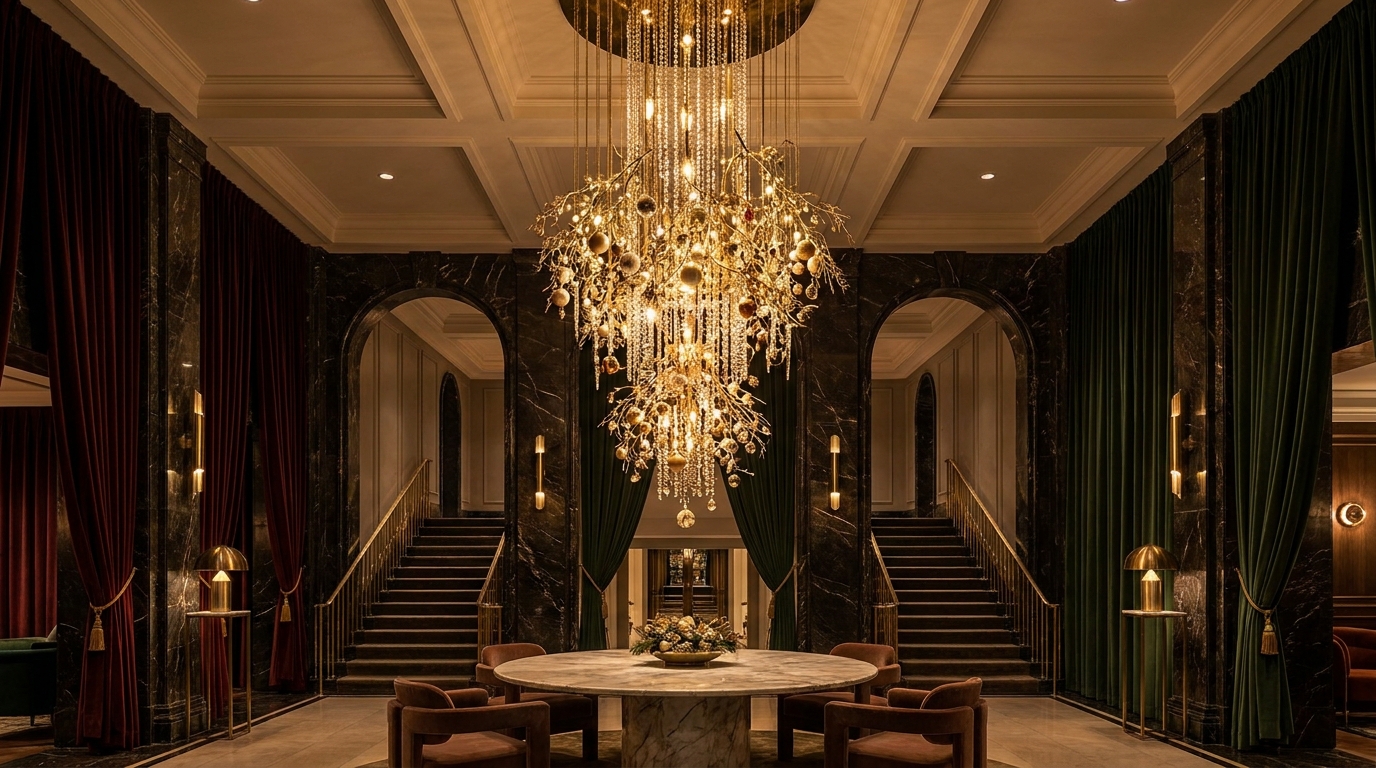
- Sculptural Chandeliers and Cluster Pendants: Create focal points in lobbies and ballrooms. Choose modular systems that allow site-specific scaling and simplified replacement modules.
- Linear LED Decorative Profiles: Ideal for balustrades, canopy edges and internal circulation paths. Provide even wash with minimal glare and discrete integration.
- Programmable Pixel or Pixel-Adjacent Elements: Use for façade mapping and interactive atrium features. Specify pixel pitch and control protocols early to align content capability with hardware.
- Festoon and String Lighting Systems: Quick to install for seasonal overlays on terraces and public plazas. Choose hardwired festoon systems with integrated LED drops rather than disposable bulbs for longevity and lower maintenance.
- Exterior Motifs and Projection-Like Fixtures: For holiday motifs, prefer backlit panels or profile-cut illuminated elements over high-maintenance discrete bulb networks.
- LED Rope and Accent Lines: For outlining architectural features; select products with robust UV and temperature resistance.
Technical Detail
- Certifications & Testing: Require CE/UKCA for EU/UK projects; UL or ETL for North America; ENEC for European electrical safety where relevant. For photometric verification, insist on LM-79 and LM-80 test reports; for lifetime claims, request TM-21 extrapolation data.
- Electrical & Surge Protection: Holiday installations are often vulnerable to transient spikes. Specify surge protection integrated at fixture or circuit level (e.g., 10 kA / 20 kA ratings depending on local conditions).
- Flicker and Visual Comfort: Use drivers and LEDs with <5% flicker at 120 Hz (or better) to avoid video artifacts and discomfort, especially in social spaces where guests record content.
- Thermal Management: Decorative forms can trap heat. Verify thermal simulations or test reports to ensure lumen maintenance and driver life are not compromised by enclosure design.
- Dimming and Control Integration: Confirm driver compatibility with intended control systems and specify control addressing and power maps in procurement documents to prevent on-site rework.
- IP and IK Ratings: For exterior holiday elements, IP65 minimum and appropriate IK ratings for vandal-prone locations. Interior decorative fixtures in humid zones or near entrances may require higher IP than usual.
- Wiring and Mounting Logistics: Provide detailed fixing points, load calculations for suspended pieces, and access panels for driver replacement. Use quick-connect cabling where feasible to accelerate seasonal install/removal.
Project Timing and Procurement Strategy
Holiday fixtures often combine bespoke elements with stock components. To meet seasonal windows without compromising quality:
-
Timeline guideline (typical custom decorative fixtures):
- Concept and approval: 12–16 weeks before production.
- Prototype and sample approval: 4–8 weeks.
- Production: 6–10 weeks depending on complexity and finish.
- Shipping and customs: 2–4 weeks for regional, 4–8+ weeks for intercontinental.
- On-site installation and commissioning: 1–3 weeks depending on scale.
-
Recommended lead times:
- Stock or standard fixtures: order 8–12 weeks before installation.
- Semi-custom (modular) items: order 12–20 weeks ahead.
- Fully custom sculptural pieces: allow 20–40 weeks (including prototyping).
-
Reduce risk with phased procurement: Lock in long-lead custom forms early while deferring color or lens options to an agreed sample stage.
-
MOQ and staging: Clarify minimum order quantities, production batch sizes and availability of spare components. Negotiate phased delivery or site-staged shipments to align with construction schedules.
Installation, Maintenance and Lifecycle Considerations
- Modular design for off-season storage: Specify fixtures that disassemble into manageable crates and protect finishes during storage.
- Service kits and spare parts: Contract for at least 5–10% spare LED modules and critical driver spares to keep seasonal displays operational with minimal downtime.
- Maintenance accessibility: Ensure maintenance staff can change modules or access drivers safely, without requiring scaffold for every minor service.
- Warranty and performance guarantees: Obtain explicit warranty terms covering lumen maintenance, color stability and finishes for a minimum of 3–5 years for holiday displays.
- Documentation handover: Insist on complete O&M manuals, luminous flux and CCT measurements, control maps and spare parts lists before project closeout.
“Decorative holiday lighting for hospitality must be designed like permanent infrastructure — beautiful in appearance but engineered for longevity, safety and predictable delivery.”
Design Trends to Consider for 2026–2027 Holiday Seasons
- Warm minimalism: Sculptural forms with warm white LEDs and brass or matte finishes to create intimate, premium atmospheres.
- Modular kinetic features: Small-scale motion elements that animate central atria or bars for dynamic holiday scenes without requiring pixel-intensive control.
- Integrated controls and content: Fixtures designed for seamless integration into hotel control systems, enabling pre-programmed holiday scenes and easy seasonal switching.
- Sustainable narratives: Use reclaimed or certified materials with visible stories — recyclable fixtures, LED with high efficacy, and lower-carbon logistics.
- Biophilic lighting accents: Combining warm accent lighting with greenery installations for an elevated, wellness-oriented holiday experience.
Conclusion
For architects and hotel designers, the success of a holiday lighting program hinges on technical specification, realistic lead times, documented compliance and an integration-first mindset. Prioritize high light quality (CRI 90+), proven photometrics, control compatibility, clear warranty terms and modular serviceability to protect the guest experience and the hotel’s operational budget.
Contact the Artilumen team to review seasonal design concepts, validate fixture selections against LM-79/LM-80 data, and establish a procurement timeline tailored to your project milestones. Our specialists support architects and hospitality designers with prototyping, compliance documentation and turnkey delivery to ensure your holiday installations dazzle on schedule and perform reliably season after season.