
Introduction
Pantone’s Color of the Year continues to shape material palettes, branding and interior schemes across hospitality and commercial projects. For architects and hotel designers, that influence extends beyond paints and textiles into the very fixtures that define atmosphere, wayfinding and guest experience. Successfully integrating a trending hue into lighting is not simply an aesthetic exercise: it introduces complex technical, manufacturing and procurement considerations that impact quality, lead time and regulatory compliance.
This article provides a pragmatic, specification-focused approach for translating Pantone color direction into reliable, repeatable lighting outcomes. We highlight the most common pain points — color accuracy, production lead times, finish durability and testing/certification — and offer clear mitigation strategies and specification checklists you can use in RFPs, FF&E schedules and lighting plans.
Key Industry Insight
Pantone-driven schemes require a systems-thinking approach. A light fixture is a composite product: metal body, finish, diffuser, lens, LED engine and driver, control systems, and wiring. Each element affects perceived color and manufacturability. When a client requests the Pantone Color of the Year, it triggers cross-discipline decisions:
- Will the color be expressed in fixtures as a painted metal finish, anodized aluminum, silk-screened glass, or integrated lens tint?
- Does the color need to match adjacent surfaces (wallcoverings, seating) or to deliberately contrast under controlled lighting?
- How will the fixture’s LED spectral output and CRI influence the perceived chroma and saturation of that color?
- What are the project timeline and MOQ constraints for custom finishes and approvals?
Addressing these questions early avoids costly change orders, extended lead times and mismatch between mockups and installed conditions.
Technical Detail
Color accuracy and consistency depend on two parallel systems: surface finish specification and light source specification.
Surface finish specification
- Convert Pantone to a manufacturable standard: Pantone -> RAL/BS/ANSI conversion alone is insufficient. For absolute match, require factory-applied physical samples using the target substrate and finish process (powder coat, wet paint, anodize, PVD). Specify tolerances in Delta E (target ≤2 for critical matches).
- Specify finish process and performance: powder coat thickness, gloss level (e.g., 10–20 GU matte), and secondary topcoats (UV stable, anti-scratch). Include environmental durability standards (salt spray ASTM B117 for coastal properties, abrasion ASTM D4060).
- Include maintenance and repair guidance: specify touch-up paints and finish remanufacturing options to future-proof lifecycle serviceability.
Light source and optical specification
- Define color rendering explicitly: minimum CRI 90 for hospitality public areas and 95 for high-end suites or art/display areas. Reference TM-30 metrics where color fidelity is critical.
- Control correlated color temperature (CCT) and color stability: specify CCT tolerance (e.g., 2700K ± 100K) and LED binning standards. Call out Delta u’v’ limits to avoid perceivable tint shifts.
- Photometric and spectral requirements: request LM-79 reports and spectral power distributions (SPDs) to understand how the LED spectrum will interact with the Pantone hue. For tunable or dynamic color schemes, provide DMX/DALI control integration requirements and scenes.
Quality, testing and certification
- Require third-party photometric testing (LM-79/LM-80) and LM-84 if applicable. For projects pursuing sustainability or energy incentives, specify DLC or Energy Star acceptance where relevant.
- Electrical and product safety: list required certifications (UL/ETL/CE/CB) and regional compliances (ENEC for Europe, BIS for India, CCC for China as applicable).
- Material compliance: demand RoHS and REACH declarations for export projects and for guests with sensitivities. For hospitality, consider low-VOC coatings to meet indoor air quality targets and WELL standards.
Supply chain and lead time management
- Custom color finishes typically increase lead time by 4–8 weeks versus standard finishes. When combined with low MOQ and multi-stage approval cycles (engineering mockup + paint sample + installation mockup), a 12–16 week lead time is common.
- Mitigation strategies: prioritize finishes into tiers (Tier 1: stock finishes; Tier 2: slight variations with short custom runs; Tier 3: full bespoke Pantone match). Lock Tier 3 decisions at early milestones (e.g., Schematic Design vs. Design Development).
- MOQ and risk-sharing: negotiate realistic MOQs with manufacturers and consider interim stock for replacement parts. Include provisions for color re-approval if production is split across batches.
Color management and mockups
- Insist on both digital and physical mockups. Digital color swatches are a starting point but are insufficient for final approval.
- Approve full-scale mockups under expected lighting conditions: daytime, night-time (accent lighting), and under final dimming control. This ensures the Pantone interpretation behaves as intended across use cases.
- Provide a final acceptance protocol tied to measurable metrics (Delta E, gloss, CCT, CRI) and include a small sample of installed fixtures to be validated post-install.
“Integrating Pantone’s Color of the Year into lighting demands precise color management across finishes, optics and LEDs — and it must be specified as a systems solution, not an afterthought.”
Implementation Roadmap for Architects and Hotel Designers
-
Early alignment session
- Convene design, lighting, FF&E and procurement teams to decide how the color will be used (primary, accent, subtle trim).
- Determine priority spaces where color fidelity matters most (lobbies, signature suites, F&B).
-
Specification language for RFPs
- Call out Pantone reference plus required Delta E tolerance on the fixture’s substrate.
- Require LM-79 results, LED bin codes, CRI/TM-30 targets, and Delta u’v’ limits.
- Include finish process, gloss level and durability testing criteria.
-
Sample and mockup schedule
- Budget for production of physical finish samples on the actual substrate and a 1–2 unit prototype luminaire.
- Schedule a full-scale mockup day for sign-off before mass production — link sign-off to payment milestones.
-
Procurement and lead time management
- Build in contingency (minimum 6–8 weeks) for finish approval and rework.
- Where possible, reserve production slots early to avoid seasonal manufacturing bottlenecks.
-
Maintenance and lifecycle planning
- Specify replacability of key components (drivers, LED boards) and availability of touch-up paints.
- Include service-level agreements with suppliers for color-matched replacements.
Case Study Brief: Boutique Hotel Lobby
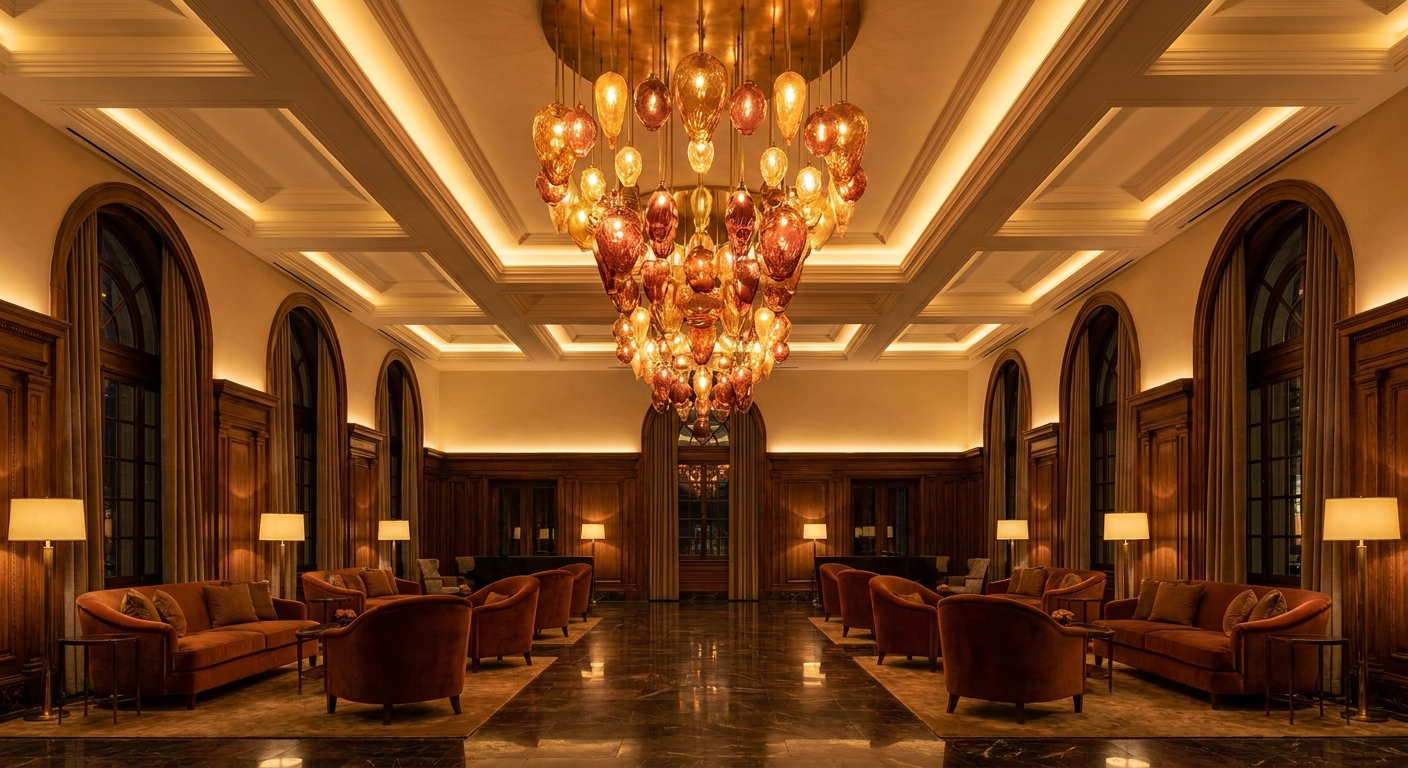
A 200-key boutique hotel specified Pantone’s 2026 accent color across upholstery, wallcoverings and bespoke pendant fixtures. Early consultation with Artilumen established:
- A Tiered finish strategy: powder coat for public pendants (Tier 2), silk-screened glass for reception desk pendants (Tier 3).
- LED specification of CRI 95 and a Δu’v’ tighter than 0.001 to preserve saturation.
- A two-stage mockup process (finish swatch + installed pendant under final lighting) reduced rework and kept production on schedule.
The result: consistent, saturated color that read consistently from textiles to metalwork, delivered within the revised project timeline due to proactive sample approval and MOQ negotiation.
Conclusion
Pantone’s Color of the Year offers a valuable directional cue for commercial interiors, but realizing it successfully in lighting requires detailed specification, rigorous testing and early vendor collaboration. For architects and hotel designers, the risks are manageable with a systems-based approach: define measurable tolerances, require factory-produced samples, account for extended lead times on custom finishes, and insist on photometric and materials certification.
Artilumen partners with design teams to translate color trends into manufacturable, certifiable and serviceable lighting solutions. Contact our specification team to discuss Pantone cross-mapping, prototype mockups, photometric testing and lead-time planning tailored to your next hospitality or commercial project. Email spec@artilumen.com or schedule a technical review to align color, light and delivery expectations.