Introduction
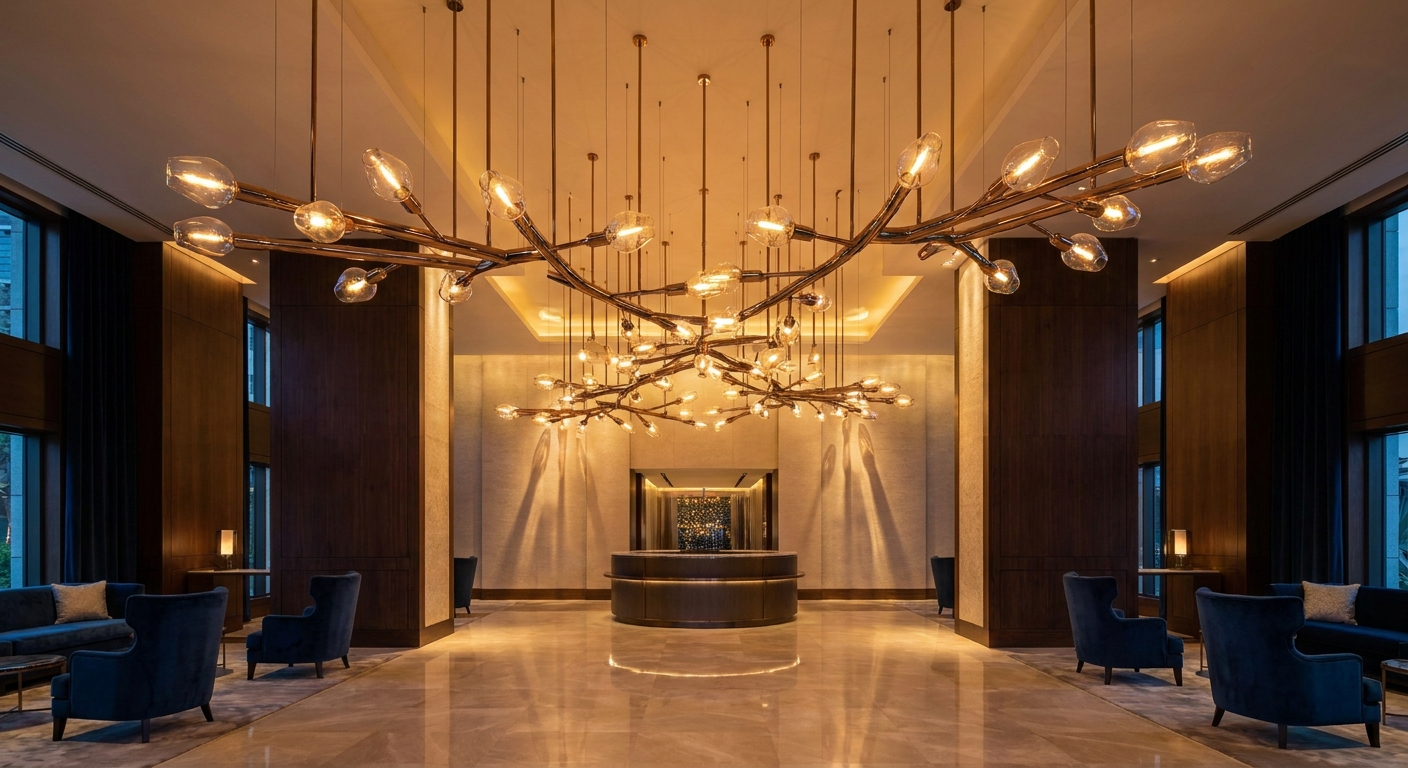
Large atriums in commercial complexes and hotels are architectural statements that demand equally ambitious lighting solutions. For architects and hotel designers, specifying giant, non-standard (custom) engineering luminaires raises unique challenges: how to balance aesthetics and performance, ensure regulatory compliance, manage extended lead times, and reduce installation risk. This article distills practical insights from Artilumen’s recent projects—focusing on quality assurance, delivery cadence, design trends, and certification—to help design teams specify resilient, buildable, and beautiful atrium lighting systems.
Key Industry Insight
Atrium lighting is no longer a decorative afterthought. It is an integrated system that must perform at several levels: visual comfort, brand expression, longevity, maintainability, and compliance. The scale and custom nature of typical atrium fixtures introduce risk in every procurement phase—from concept and shop drawings through manufacturing, site handling, and commissioning. Understanding where those risks concentrate (optical performance, thermal management, structural interface, controls compatibility, and logistics) allows design teams to make informed trade-offs early in the project.
Common B2B pain points:
- Quality and consistency: color accuracy, lumen maintenance, and finish durability across multi-piece assemblies.
- Lead time and schedule integration: custom engineering often extends procurement to 12–24 weeks or more.
- Certification and documentation: client and code requirements demand LM-79/LM-80, CE/UL, and seismic/fire validations.
- On-site complexity: craning, temporary supports, staged hoisting, and co-ordination with MEP and AV trades.
Addressing these systematically reduces change orders, saves time on site, and protects design intent.
Technical Detail
Optical and photometric considerations
- Specify performance metrics, not just look. Require LM-79 photometric reports for the final fixture assembly (not only the LED module). Insist on measured luminous intensity distributions (LID) and lumen maintenance (LM-80 and TM-21 projections) for project life-cycle predictions (e.g., L70 @ 100,000h).
- Color consistency is critical at scale. Require a max 3-step MacAdam ellipse and document CCT options (2700K–4000K commonly used in hospitality atriums). For high-end finishes, CRI ≥ 90 or TM-30/IES metrics should be included.
Thermal and electrical engineering
- Large luminaires often conceal long LED runs and drivers. Verify thermal simulations and return-air assumptions. Specify driver placement with accessible service points—remote driver locations and spare capacity make future servicing much easier.
- Power distribution: confirm voltage drop calculations for long feed runs and design redundancy for critical venues. Include surge protection, inrush limiting, and in-built micro-fusing where applicable.
Structural integration and safety
- Early structural coordination is non-negotiable. Provide detailed load schedules, anchor types, and seismic restraint designs for review by your structural engineer. Large suspended fixtures may exceed beam capacities and require secondary steel or dedicated hangers.
- Fire and egress considerations: furnish fire-rated penetrations details, flame-spread data for materials, and coordination with the fire protection engineering team. Where required, specify fail-safe mechanisms and emergency lighting integration.
Controls and integration
- Specify controls protocols (DALI-2, DMX, BACnet, KNX) upfront and define who provides the network architecture. For hospitality atriums, zoned tunable white and scene-setting via DALI-2 DT8 or control gateways are typical.
- Demand interoperability testing. Require pre-shipment factory acceptance tests (FAT) with the end control system or an agreed emulation to reduce commissioning time on site.
Finish and material durability
- Large signature pieces are exposed to cleaning, sun, and HVAC loads. Specify finishes with salt-spray, UV, and abrasion resistance where applicable. Provide maintenance procedures and spare parts lists (diffusers, suspension cables, LED modules).
Manufacturing, lead time, and delivery strategies
- Typical lead times vary by complexity: off-the-shelf fixtures can ship in 4–8 weeks; bespoke atrium sculptures commonly require 12–24 weeks. To mitigate schedule risk:
- Break the scope into buyouts: approve long-lead items early (drivers, custom extrusions).
- Stage deliveries: ship components for early long-lead items like secondary steel and canopy while finishing aesthetics.
- Request an accelerated prototype run with a narrower scope to gain early verification of finishes and light quality.
- Include buffer weeks for FAT, packaging revisions, and export logistics.
Logistics, packaging, and installation
- Oversized fixtures demand specialized packing and lifting plans. Ask for rigging diagrams, single-lift vs multi-lift recommendations, and certified weight reports.
- Insist on site mock-up hoisting trials when possible. Craning clearances, temporary supports, and lay-down areas must be planned in the construction schedule.
- Guarantee that spare parts (suspension hardware, LED modules, driver modules) are bundled in the final shipment and documented in a field service kit.
Certification and documentation
Regulatory certificates
- For international projects, require CE (EU), ENEC (Europe for components), or UL/ETL (North America) documentation as applicable. Confirm that these certificates apply to the final assembled product where possible.
- For seismic jurisdictions, provide calculations and testing or reference to published standards (e.g., ICC-ES reports, RISA verifications).
Performance documentation
- Require a full documentation package: shop drawings, structural load schedules, maintenance manuals, spare parts list, wiring diagrams, FAT reports, photometrics (IES files), and BIM/Revit families. These reduce RFIs and accelerate sign-off.
Warranty and service support
- Large custom fixtures should include a commercially meaningful warranty (3–5 years typical) and end-of-life service options such as driver replacement, LED module upgrades, and refinishing. For hospitality environments, define response times for on-site troubleshooting.
“Designing for grand atriums is a multidisciplinary challenge—successful outcomes come from aligning architectural intent with rigorous engineering, realistic procurement timelines, and clear documentation.”
Conclusion
Architects and hotel designers who specify monumental, custom lighting for atriums must treat luminaires as engineered systems as much as art. Prioritize measurable performance (photometrics, thermal, structural), build realistic procurement and installation schedules, and insist on complete certification and documentation. Artilumen’s approach is to partner early: we provide engineering resources, prototyping services, BIM assets, and a structured FAT and delivery program to reduce site risk and protect design integrity.
If your upcoming project includes a signature atrium or large-scale custom fixture, contact the Artilumen design and engineering team. We will provide a tailored feasibility review, lead-time mitigation plan, and sample schedule to align lighting delivery with your construction milestones.