
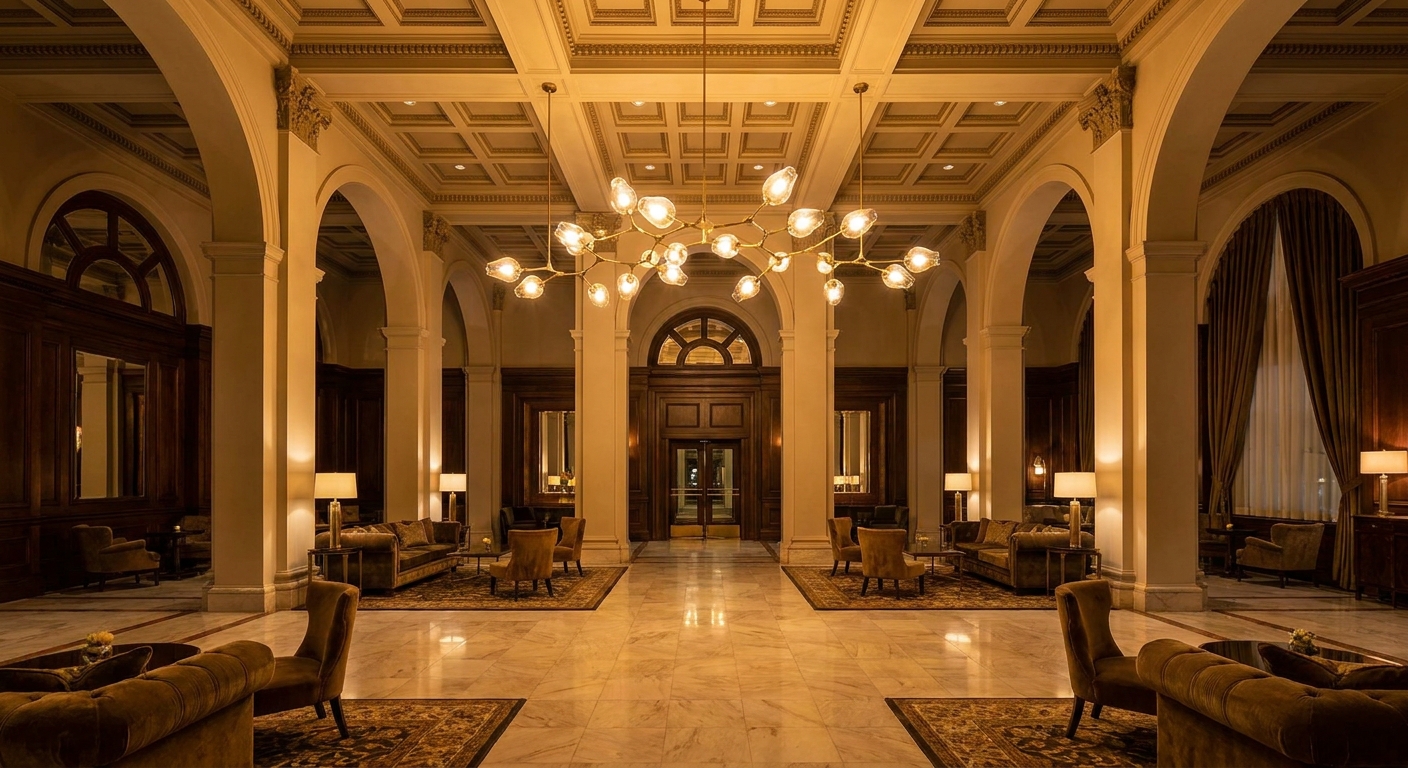
Introduction
As hotel and commercial projects accelerate worldwide, architects and hospitality designers are facing intensified pressure to deliver immersive, code-compliant lighting schemes on compressed schedules and tighter budgets. In 2026 the market presents a unique mix: robust demand for experiential lighting, stronger sustainability and certification requirements, and ongoing supply-chain volatility that still affects lead time and customization. For design teams and procurement managers, the priority is no longer just aesthetic success — it’s specifying resilient, verifiable, and serviceable lighting systems that protect design intent through construction, commissioning and operation.
This article synthesizes the most relevant market opportunities and practical challenges for commercial buyers in 2026, with specific guidance on design trends, performance specifications, lead-time mitigation, testing and certification expectations, and procurement best practices for hospitality and large-scale commercial projects.
Key Industry Insight
The commercial lighting market in 2026 is shaped by three concurrent forces: experiential design, regulatory rigor, and supply-chain pragmatism.
- Experiential design: Hotels and flagship commercial spaces are investing in layered, human-centric lighting (HCL) and dynamic scenes that reinforce brand and guest experience. Tunable white, high-CRI accents, and integrated façade and landscape systems are now standard in premium projects.
- Regulatory rigor and sustainability: Energy codes (IECC, ASHRAE 90.1 updates), WELL, LEED and regional eco-labels have raised the bar for efficiency, controls integration and documented performance. Owners demand lifecycle reporting and higher assurance of recyclability and material transparency.
- Supply-chain pragmatism: While raw-material shortages have eased compared with earlier pandemic peaks, manufacturers still contend with semiconductor allocation, logistics variability, and workforce constraints in key manufacturing hubs. This impacts lead time and increases the value of local assembly and modular design.
For designers specifying lighting, the practical implication is to combine aspirational lighting goals with a procurement strategy that prioritizes demonstrable performance, traceable certifications and realistic delivery timelines.
Market Opportunities
- Premiumization in hospitality: High-end hotels are allocating more of their FF&E budget to lighting as a differentiator. Custom fixtures and integrated control experiences present lucrative opportunities for manufacturers who can guarantee consistent color and rapid prototyping.
- Retrofit demand in commercial portfolios: Corporates and multi-site hotels are pursuing upgrades for energy savings and guest wellbeing, creating repeatable product families and smart controls packages.
- Regional growth pockets: The Middle East and APAC continue to show above-average investment in new hospitality venues, while North America and Europe push retrofits tied to sustainability mandates.
Core Challenges for Buyers
- Quality risk vs. cost pressure: Low-cost fixtures frequently fail to meet photometric, lumen maintenance and color consistency expectations, increasing rework and lifecycle cost.
- Lead-time variability for customization: Bespoke luminaires, finishes or integrated IoT features may add several weeks to months to the schedule.
- Certification complexity: Projects spanning multiple jurisdictions require careful attention to UL/ETL, CE/UKCA, ENEC, CCC and local energy compliance. Noncompliance causes delays and costly rework.
Technical Detail
Design teams must translate aesthetic aims into technical performance criteria that suppliers can reliably meet. Below are key specifications every architect and hotel designer should insist on.
Photometric and Electrical Testing
- LM-79: Require independent LM-79 photometric reports for the proposed luminaire. These report lumen output, efficacy (lm/W), wattage and spatial distribution under standardized testing conditions.
- LM-80 and TM-21: For LED source longevity assertions, demand LM-80 test results for the LED modules and TM-21 lumen maintenance projections. Avoid unverified lifetime claims.
- Flicker and dimming: Specify flicker metrics (percent flicker or Pst LM) and dimming compatibility with chosen control systems. Low-flicker designs are essential for HCL and long-stay hospitality settings.
- Power quality: Insist on THD and power factor data for large circuits to prevent nuisance tripping and to ensure energy-model accuracy.
Color Quality and Consistency
- CRI and beyond: CRI (Ra) remains a baseline, but require TM-30 metrics (Rf/Rg) and R9 values for materials and skin tones. R9 > 50 is increasingly expected in hospitality accent lighting.
- Color consistency: Specify SDCM (MacAdam steps). For critical accent and luminaire families, 3-step SDCM or better minimizes visible shade differences across multiple fixtures and batches.
- Correlated Color Temperature (CCT) and tunability: For HCL applications, define DT8/DALI-2 or equivalent control capabilities, including tunable white ranges (e.g., 2700–6500K) and scene recall accuracy.
Environmental and Mechanical
- IP/IK ratings: Exterior and public-area fixtures should have appropriate IP protection (e.g., IP65 for exposed façades) and IK rating for impact-prone locations.
- Material and finish longevity: Specify salt-spray, UV and abrasion test requirements when finishes are critical to the aesthetic and maintenance lifecycle.
- Serviceability: Prioritize fixtures with accessible driver compartments, modular optics and replaceable parts to reduce lifecycle cost and onsite downtime.
Controls and Connectivity
- Protocols: Specify control platform compatibility early in the RFP (DALI-2, DALI-2 DT8, Matter, BACnet, Zigbee, PoE). Interoperability reduces commissioning risk.
- Remote commissioning: Request remote commissioning capabilities and OTA update support to minimize on-site technical calls and accelerate final tuning.
- Data and analytics: For large estates, plan for telemetry requirements (energy monitoring, lumen depreciation tracking) and clarify data ownership and privacy.
Procurement and Lead-Time Management
Lead time remains one of the most impactful risk factors for commercial projects. Here are pragmatic approaches to protect schedule and design integrity.
- Early supplier engagement: Engage manufacturers at concept stage for feasibility, lead-time estimates and prototyping. Early collaboration short-circuits surprises during FF&E procurement.
- Prototype and mock-up cadence: Budget for a lighting mock-up and one round of revisions. A signed mock-up reduces risk of field rework and color-mismatch disputes.
- Tiered specification strategy: Use performance-based specs with an approved manufacturer list. For long-lead bespoke items, specify brand/model to lock availability.
- Buffer windows: For standard fixtures expect 8–14 weeks typical lead time (regional variances apply). For customized fixtures, allow 14–26+ weeks. Factor logistics and customs clearance into final delivery scheduling.
- Local assembly and pre-install kits: Where possible, require local final assembly or pre-packaged installation kits to reduce on-site labor and rework.
Compliance, Certification and Documentation
Certifications are not optional for institutional procurement. The minimum documentation set for acceptance should include:
- Third-party test reports: LM-79, LM-80, TM-21 and any regional energy compliance certificates.
- Safety and regulatory marks: UL/ETL for North America; CE and UKCA for Europe/UK; ENEC for product conformity in certain European markets; local approvals as required.
- Warranty and service terms: Define warranty scope (lumen maintenance, driver, product) and specify remedy timelines. For hospitality, rapid replacement clauses are often necessary.
- Sustainability data: Material disclosure, recyclability, and manufacturer EPR or take-back programs for circularity commitments.
“Design success in 2026 requires marrying ambitious lighting intent with verifiable performance and pragmatic procurement. Early technical clarity and supplier collaboration protect both design and schedule.”
Conclusion
The 2026 commercial lighting landscape rewards designers and hoteliers who balance creative ambition with disciplined specification and procurement. Prioritize fixtures with independent photometric validation, clear certification paths for each region of installation, and modular, serviceable designs that reduce lifecycle cost. Mitigate lead-time risk through early manufacturer engagement, prototyping, and realistic schedule buffers — and insist on controls interoperability and data-ready systems to future-proof hospitality experiences.
Artilumen is prepared to partner with architects and hotel designers at every project stage—from concept validation and mock-ups to documentation, certification support and post-install service. Contact the Artilumen design and specification team to review product families, validation reports and lead-time scenarios tailored to your project requirements. Together, we can protect design intent while delivering compliant, compelling lighting solutions on time and on budget.