
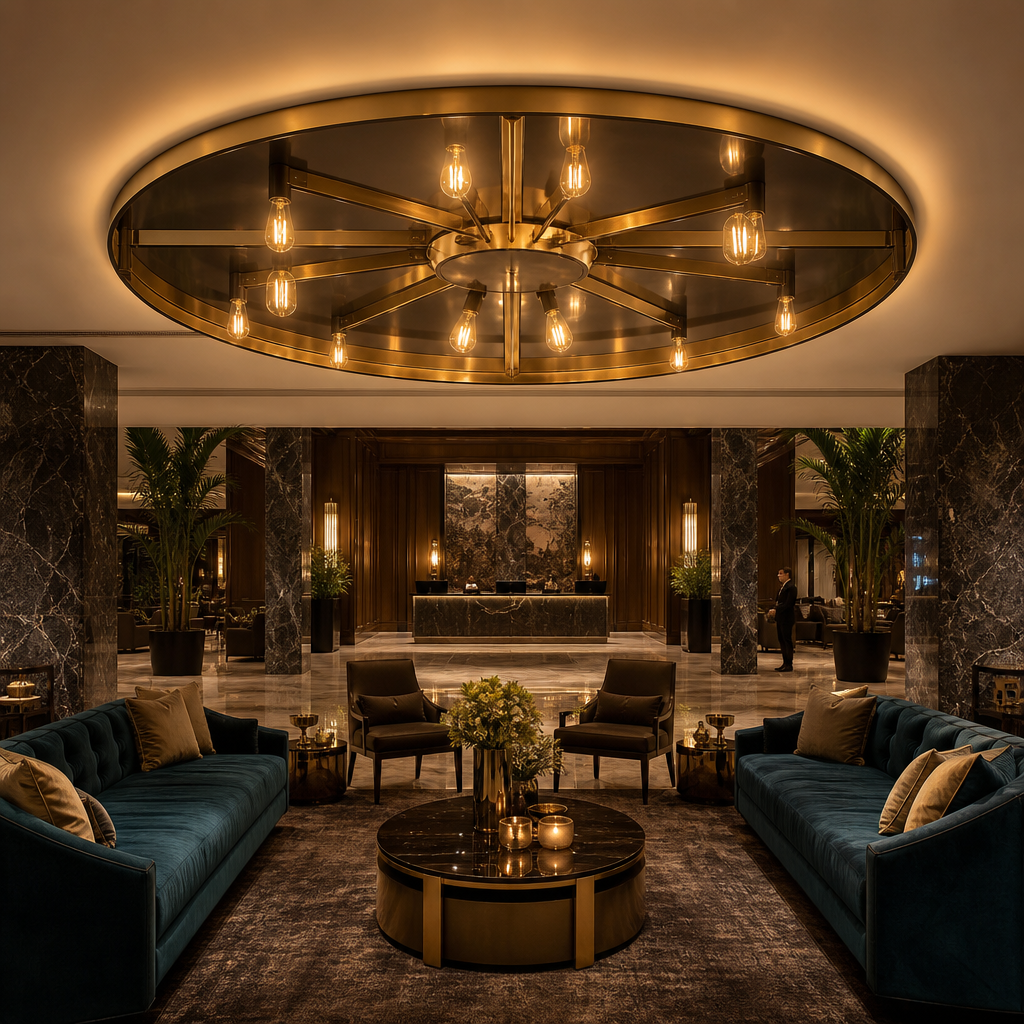
Introduction
Ceiling lamps often appear to be the simplest part of a lighting layout. In reality, they are among the first fixtures to be value-engineered and among the most common sources of installation conflict in hospitality projects. Architects and hotel designers are trained to think in terms of visual experience, but on site the ceiling plane is crowded with sprinklers, ducts, speakers, sensors, and structure.
A ceiling lamp’s diameter and overall height determine whether it can coexist with those systems. Its lamp base determines how easy it will be to maintain across a large property. And its quality and documentation determine whether it can be delivered on schedule and approved in time.
This quick-reference guide translates the essential parameters — diameter, height, and E27/E14 lamp base selection — into practical, procurement-ready guidance for commercial buyers.
Key Industry Insight: Specifications Are Risk-Management Tools
For a hospitality project, a lighting specification is not just a design statement. It is a procurement contract. Every dimension and lamp base decision affects installation, operation, and long-term maintenance. A ceiling lamp can be beautiful in a render and completely wrong in the field if its physical parameters are not coordinated with the real ceiling conditions.
“A specification is not complete until it can be installed, operated, and maintained within the realities of a project schedule.” — Liz Lin, Lead Lighting Strategist at Artilumen
Diameter: Proportion, Photometry, and Ceiling Grids
Diameter is the first ceiling lamp parameter to verify. It influences scale, light distribution, and how the fixture interacts with the ceiling layout.
In a hotel guestroom, a large-diameter ceiling lamp can dominate the space and make the ceiling feel lower. In a lobby or restaurant, a small fixture can look lost and create uneven illumination. A common mistake is to choose a fixture based on its visual weight in a photograph without checking its diameter against the actual room volume.
Diameter also matters for technical coordination. In modular ceilings, a large ceiling lamp may overlap grid intersections, air diffusers, or sprinkler heads. In drywall ceilings, a larger fixture may require additional support beyond a standard junction box. Always confirm the diameter with the ceiling layout before finalizing the specification.
Photometrically, diameter is not directly equal to beam spread, but it is often related to the optical system. A wider fixture can house a larger reflector or diffuser, which may create softer ambient light. A smaller fixture may require a more concentrated light source. Request IES or LDT files early to verify the distribution.
Height: The Silent Coordination Constraint
Height is the most underestimated ceiling lamp parameter in hospitality projects. A low-profile flush mount can disappear into the ceiling, while a semi-flush fixture can become a strong visual anchor. But the physical height of the fixture must be checked against ceiling height, sightlines, and nearby equipment.
In low-ceiling corridors, a deep ceiling lamp can intrude into the circulation path. In guestrooms, a fixture directly above the bed needs to be considered from a lying-down position to avoid glare or a sense of enclosure. In public restrooms or back-of-house areas, the fixture height may also affect accessibility and maintenance access.
There are two height measurements to review: overall fixture height and mounting height. Overall height is the distance from the ceiling plane to the lowest point of the fixture. Mounting height is the distance from the finished floor to the fixture’s lowest point. Both must be noted in the specifications and checked against the architectural sections.
If the project uses a semi-flush or close-to-ceiling fixture, pay attention to how much space is needed between the ceiling and the diffuser for air circulation, lamp replacement, and driver access. A fixture that is difficult to relamp will increase labor costs over the life of the building.
E27 vs. E14: A Maintenance Decision in Disguise
Lamp base selection is often treated as a small detail, but for hotel operators it is a recurring operational concern. E27 and E14 are both Edison screw base sizes. E27 has a 27 mm thread diameter; E14 has a 14 mm thread diameter. They are not interchangeable.
E27 is the larger, more common base for many LED retrofit lamps. It is widely available in Europe, Asia, and other markets. E27 fixtures can usually accept larger lamps with higher lumen output, which makes them useful for ambient lighting in lobbies, corridors, and larger rooms.
E14 is the smaller base, often used in compact decorative fixtures where space is limited. E14 lamps are available as candle-shaped or small globe lamps, but the range of high-lumen, high-quality LED options can be more limited in some regions.
Why Lamp Base Choice Affects Long-Term Operations
For a large hotel project, the choice between E27 and E14 is not just about lamp size. It is about availability, standardization, and maintenance staff familiarity.
If a hotel uses hundreds of ceiling lamps in guestrooms and corridors, the operator will need to stock replacement lamps. A standardized E27 lamp base may simplify inventory and reduce the number of SKUs. An E14 base may be necessary for a particular fixture design, but replacement lamps must be available locally to avoid extended downtime.
In addition, dimming compatibility is a critical factor. Not all LED lamps perform well with hotel dimming systems. If the ceiling lamp uses E27 or E14 sockets, the selected LED lamp must be tested with the project’s dimmer. If the ceiling lamp uses an integrated LED module, the driver becomes the main compatibility component.
Another common issue is physical fit. Some LED lamps are larger than the incandescent lamps they replace, even with the same base size. When specifying a ceiling lamp, verify that the intended E27 or E14 lamp will fit inside the fixture’s canopy without touching wiring, drivers, or thermal protection components.
B2B Procurement: Quality, Lead Time, and Certification
Commercial ceiling lighting is not a shopping decision. It is a supply chain decision. B2B buyers need to evaluate quality, lead time, and certification before approving samples.
Quality Assurance and Documentation
Quality in ceiling lamps is about consistent finish, reliable LED performance, thermal management, and long-term durability. A high-quality fixture should deliver uniform light without visible flicker, mismatched color temperatures, or premature driver failure.
Request photometric files and product datasheets before making a decision. A manufacturer who cannot provide IES files, wiring diagrams, or installation instructions should raise a red flag. For hospitality projects, sample testing is strongly recommended. Mount the fixture in a mock-up ceiling and evaluate its visual scale, light distribution, and ease of installation.
Certification requirements vary by project location. Depending on the market, ceiling lamps may need to comply with regional electrical safety standards and energy efficiency regulations. Always ask the manufacturer for valid certification reports and declarations of conformity. At Artilumen, we provide compliance documentation for specific markets — contact us for details.
Lead Time and Logistics
Lead time is often the hidden variable in lighting specifications. Ceiling fixtures with custom finishes, special sizes, or integrated LED modules may require longer production time than standard catalog items. During a hotel renovation or new construction, delayed lighting delivery can affect the entire commissioning schedule.
To manage lead time risks, confirm production and delivery schedules early in the project. For large room counts, request a pre-production sample and clarify whether the manufacturer can support phased delivery. If the project needs fast turnaround, consider specifying standard mechanical dimensions and common lamp bases — E27 and E14 included — to simplify replacement and reduce custom component lead time. Contact the Artilumen team for current lead times and logistics options.
Design Trends: From Minimalism to Mixed Materials
Current hospitality design continues to move away from purely decorative ceiling fixtures toward more architectural lighting solutions. Ceiling lamps are increasingly selected for their ability to blend into the ceiling or to make a precise material statement.
Low-profile fixtures with fabric, glass, or metal diffusers are popular in boutique hotels. Warm color temperatures and glare-free diffusion are key to creating comfortable rest environments. E27 and E14 sockets remain relevant because they allow designers to choose decorative LED lamps that contribute to the visual character of the fixture.
At the same time, operators are demanding more practical design: minimal dust accumulation, easy relamping, tool-free access, and replacement parts that do not require a full fixture teardown. These requirements should be written into the specification, not assumed from a catalog photo.
Conclusion
Ceiling lamp specification is a balance between design intent and operational reality. Diameter determines proportion and light distribution. Height determines coordination and visual comfort. E27 and E14 base selection determines long-term maintenance and lamp compatibility. Quality, certification, and lead time determine whether the project can be delivered as planned.
Before you approve a ceiling lamp for a hospitality project, ask the manufacturer for detailed dimensions, photometric files, compliance documentation, and lead time information. If a seller cannot confirm these details, that is a signal to look elsewhere.
Artilumen specializes in commercial lighting for architects, hotel designers, and project buyers. We can support your specification review, sample evaluation, and custom project needs. Contact us for details and let our team help you specify with confidence.